Dyno Tuning Tech Tips for Harley-Davidson Motorcycles | Hot Bike

We’re back with another installment of Hot Bike Tech Tips, and this time we’re diving into a subject that sparks plenty of opinions but not always enough understanding—dyno tuning. Dyno tuning is one of the most critical steps in making a Harley-Davidson run correctly, yet many riders don’t fully understand what’s happening when their bike is strapped down and spun up.
The goal here is simple: give you a working knowledge of what your tuner is adjusting, how the dyno itself functions, and why certain decisions are made during the tuning process. Whether you’re watching tuning videos online or talking with someone who’s had their bike tuned, this overview will help you better understand what’s going on behind the scenes.
Open Loop vs. Closed Loop Fuel Injection
Modern Harley-Davidson fuel injection operates in two modes: open loop and closed loop.
In open loop, the ECU relies entirely on values programmed into the tune. It decides how long the fuel injector stays open based on preset tables, with no real-time feedback.
In closed loop, the ECU reads data from the oxygen sensors in the exhaust and constantly adjusts fueling to hit a target air-fuel ratio. These targets live in tables based on engine speed (RPM) and manifold pressure. Each cell contains a desired air-fuel ratio—often something like 14.4:1 for cruising conditions—and the system actively works to hit that value.
To calculate fuel delivery, the ECU considers engine displacement and injector size. Harley-Davidson fuel injectors are rated in grams per second (g/s). A stock Milwaukee-Eight injector flows 4.38 g/s, but larger engines, aggressive camshafts, and higher horsepower builds require larger injectors to keep up with demand.
Understanding the Dyno Hardware

The dynamometer is simply a diagnostic tool, and in this case the unit being used is a Dynojet Research 250i. Dynos can be installed flush in the floor or left above ground. Above-ground installations are often preferred because they’re far easier to service and maintain.
To begin a dyno session, the bike is rolled onto the unit, the front wheel is secured in a movable chock, and the rear tire is centered on the drum. That drum is the heart of the system—it measures torque, which is the only force the dyno directly records.
Horsepower isn’t measured directly. It’s calculated using torque and engine speed:
Horsepower = Torque × RPM ÷ 5,252
The drum is connected to an eddy current brake, an electromagnetic system that applies controlled resistance. This allows the tuner to hold the engine at a specific RPM, wheel speed, or load. In this setup, 13% load closely simulates riding on a flat road, making it ideal for real-world tuning.
Reading Air-Fuel Data and VE Tables

Accurate dyno tuning depends on precise air-fuel readings from both cylinders. This is done using wideband oxygen sensors, ideally placed as close to the cylinder heads as possible. If an exhaust doesn’t have sensor bungs, they’re added to ensure clean data.
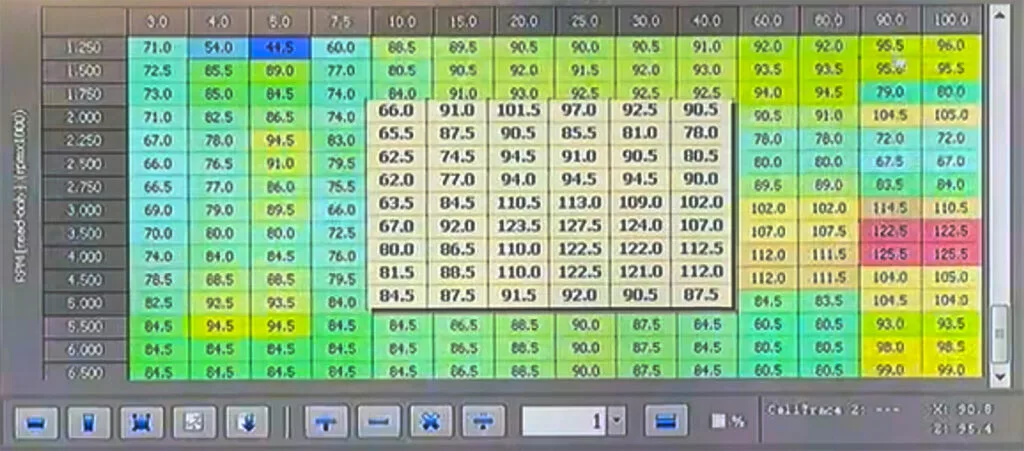
Once the data is logged, the tuner adjusts the volumetric efficiency (VE) tables, which are expressed as percentages and can exceed 100%. VE tables are mapped by RPM and throttle position. Increasing a value adds fuel; decreasing it removes fuel.
Front and rear cylinders are tuned independently, and their VE values are rarely identical. A proper tune focuses heavily on the RPM and throttle ranges where the bike spends most of its time—typically the middle of the map—not just wide-open throttle. Big horsepower numbers don’t mean much if the bike runs poorly in everyday riding conditions.

Gearing, Data, and Real-World Results
Most dyno runs are performed in fourth or fifth gear, with fifth being a common choice to avoid speed limiter issues. Throughout the session, the dyno software displays ambient conditions, drum load, engine RPM, throttle position, spark advance, manifold pressure, and air-fuel ratios for both cylinders.
Dyno tuning isn’t about chasing peak numbers—it’s about creating a smooth, predictable, and efficient motorcycle that performs where you actually ride it.
For riders who want to go deeper, there’s a full supporting video on the Hot Bike YouTube Channel that breaks down the process with visuals and real-time examples. HB
SOURCE:
MOTORWITCH INDUSTRIES // motorwitchindustries.com
DYNOJET // dynojet.com