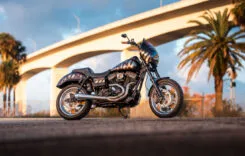
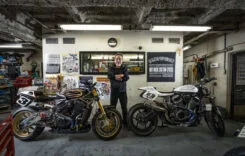
Great FX-tations: Kyle Rice’s custom 1992 Harley-Davidson FXR

Way back when none of us were born, Charles Dickens wrote a coming-of-age novel about a kid named Pip in Victorian England. No, not the one they made into a Muppet movie. That’s the book about the grouchy banker who gets his mind right after three ghosts take turns kicking his brain’s ass. I’m talking about Great Expectations. And just like how the main character in the book learns and grows throughout the book, Kyle Rice has learned a lot about the bike builder’s craft over the years, growing and overcoming its inherent challenges to be the craftsman who turned this 1992 Harley-Davidson FXR into a pretty cool chopper. Or, as he tells it, “I wanted to challenge myself and push my limits; feel the pressure. I wanted to be perfect but quickly realized that wasn’t happening. I wanted to become a better fabricator (and show what I’ve learned over the last few years), be a better sheet metal shaper, a better painter, and a better upholsterer than I was. I feel like I’ve dreamt of this bike for years, waiting to fi nd my style and build up the skill level to actually make it happen. I’ve been chasing this one for a while.”
His history with chopped iron goes back a couple of generations. Kyle’s grandfather also built choppers way back in the day, like sketchy long chops in the ’60s in Southern Illinois. He had Harleys, BSAs, and Triumphs. He messed around with everything mechanical, and so did Kyle’s father. Unfortunately, grandfather passed away a year after Kyle was born. That left Kyle with stories and photos. “I wanted to build this bike to keep that flame burning. I think my grandfather would be proud of this one.”
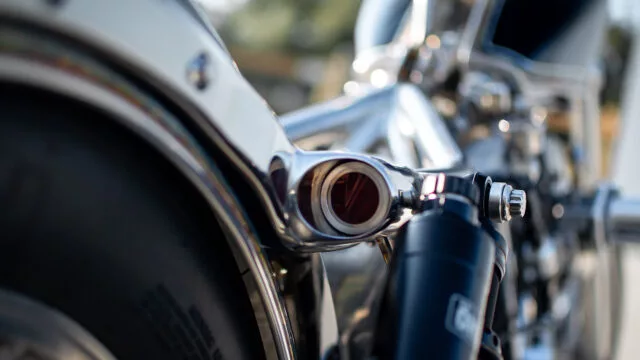
Kyle also drew inspiration from real-deal legendary custom gods, too: “John Harman is one of my favorite builders. Towards the end his style was so aggressive, I always wondered what would exist if he lived longer. Bill Dodge, FNA, Alleyway, they were always at the Florida shows so their work definitely rubbed off on me. Arlen Ness’ “Untouchable” is a specific bike that I found inspiring. It was his first, that he would cut up every year to keep going to the shows. The name was so fitting for the bike too.”
The build itself kicked off when Kyle got his hands on a few 19-inch Morris mag wheels. “I really dig Motomags and Kimtabs,” he says. “I drew up a ‘X’ brace and had them waterjetted to weld in between each spoke. But I wound up getting an 18-inch Morris from my buddy Justin Valcourt which would be right for a M&H Racemaster that I always wanted to run.”
Wheels wouldn’t be the only things he’d weld and fabricate on to make just right for the build. As fate would have it, Kyle also had an FXR swingarm laying around. “I essentially copied it but in 1.25-inch chromoly tubing. I extended the axle adjustment range another inch (mostly to clear the 28-inch rear tire). At this point I really was just stacking parts for a cool little FXR swingarm-based chopper. I took a few months away from the garage ‘til I realized I really wanted to cut up my first build. It really lit a fire under me.” That first build was what Kyle originally thought was his dream bike. At the time he made the bike, it was exactly that. He says, “It was a massive shovelhead in a FXR frame that I turned into a dirt bike/tracker looking thing. The idea was to build a fun haver with an old big V-twin. It actually got to a point where I was almost embarrassed to show it, quality-wise. I had just gotten a lot better as a builder after that.” He realized the quickest way to get a real project going was to just cut that one up and use the parts for a second shot at said dream bike.
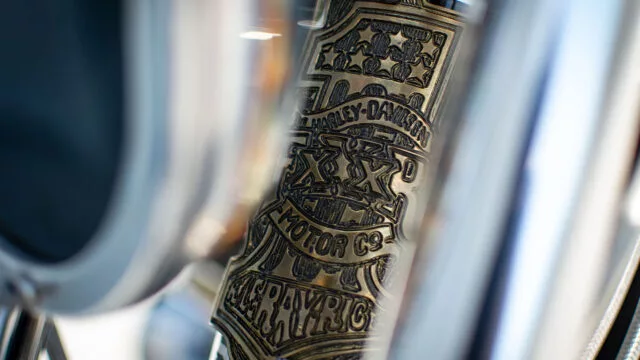
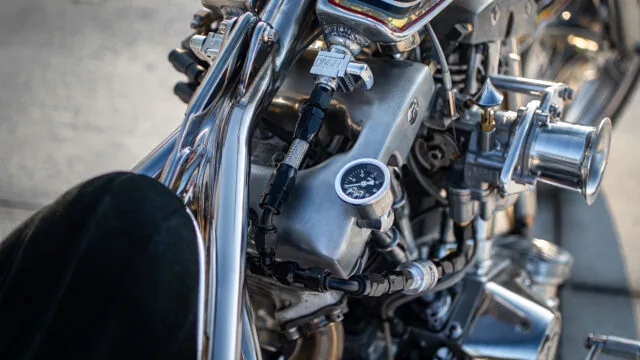
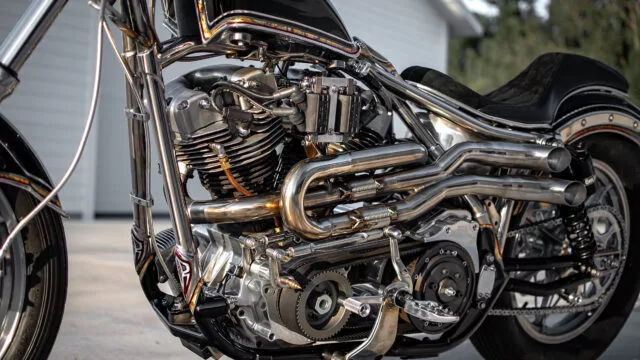
The idea was to cut the neck in order to retain the real H-D VIN. If you’ve ever tried to register a custom frame with the DMV, you know exactly why keeping an existing VIN was a good idea. Kyle also utilized the bottom frame rails with the rubber mounts and retained all of the stock drivetrain.
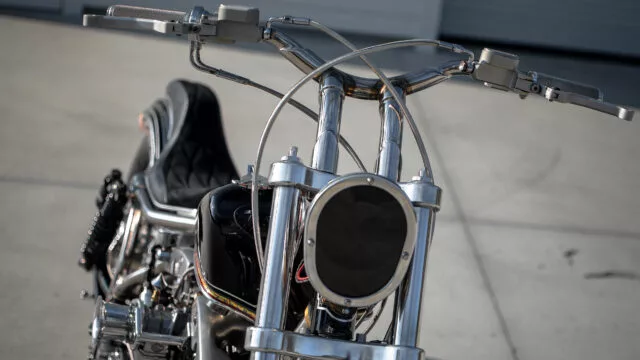
Inspiration also hit while Kyle worked all of that out: “Stainless metal finishing clicked with me at some point and I had to figure out a way to make it work. A lot of the stainless work came from watching Brian Buttera and Christian Newman. Buttera was super clean and simply and Newman was insanely clever and intricate. Watching them build stainless frames is 100-percent why I did mine. So, I decided to slug the joints between the FXR bottom rails to the stainless tubing, plug weld those it and for extra insurance create stainless sleeves to be welded completely over those joints.” The backbone, county bar, top mount, and shock tower/rear frame section were the most challenging parts of this process, though. “The backbone and country bar are two tubes completely welded together like a double barrel shotgun that splits and becomes the rear section,” Kyle continued. “Every tube intersection I bent the ends made the transitions flow a bit more. And a lot of the bends follow the lines of the Shovel engine, fenders, etc. At this point the entire build was planned out, and everything was made to fit the next step. I then made bars to match the plan in my head.”
Part of that mental plan called for some pretty cool subtlety, too. “To me doing a mild chop is super unique. Most people that go as far as to chop something will normally go wild,” Kyle says. “Like not a lot of guys chop a roof on a car just one inch. But that’s a detail only the trained eye will see. I really dug the idea of making the rake mild and making it up with the fork tubes. It had no negative effect on the trail. It actually didn’t affect it at all.”

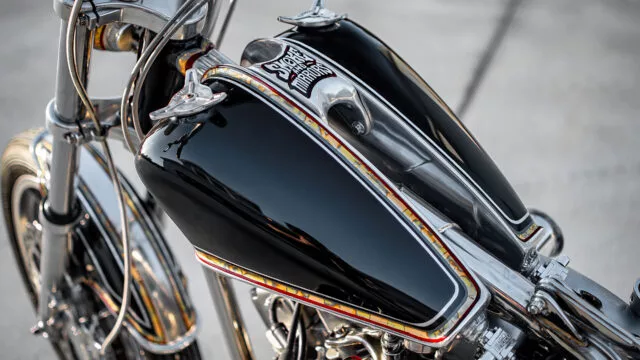
The metal look continued on into the bodywork, too. The sheet metal is all-aluminum, and the tanks are the third rendition made for the bike. The tank bottoms flare out like you’d find on a Johnny “Chop” Vasko project. Kyle polished the undersides and built some underside rubber mount brackets for them; they almost resemble butterfly wings. The front and rear fenders are made from 0.125- inch aluminum. Kyle wanted them to be tough, especially the rear in case it needs to hold a passenger. “I rolled some aluminum tubing and split it in fours to create the ridge they have on the sides. It was a ton of welding but I’m especially proud of them. All the sheet metal I had intended to be polished and I masked off the areas to remain metallic through paint. The raw polished metals became part of the paintjob.” The 3 he painted on the side has a lot of meaning to him also. Kyle’s racing number was 37. He had a thing with threes and sevens.
That paintjob may have been the hardest part of the whole project, too. It took at least a year longer to create than Kyle thought it would: “At times it felt like there was failure at every step. I learned a lot. Painting was rough. I painted the bike in August of ’23 in South Florida. At the time, we had been experiencing the worst heat wave in a long time. I had to paint in a driveway under a canopy (which I’m grateful to even have had access to). Mosquitos would get bad at night so realistically I could only spray really early before the heat hit 100-plus degrees. That eliminated painting weekdays for me. I experienced solvent pop for the first time, which really wasn’t a big deal with how much I was cutting and flow coating over the art. The paint process was just slow.”

There was an art to the seat process, as well. Kyle didn’t use just one material to upholster it like most of us would. He covered his saddle in half-suede half-leather, with a faded diamond stitch on the suede. It sits on a nice aluminum pan that hinges upward for access to the electrical system.
At times Kyle really struggled with the project. It’s wild how a side project can spiral your mood. He says, “It would constantly make me feel inexperienced at every turn. I spent all of two years constantly trying to problem solve, completely obsessed with it. That eventually turned into ‘Why am I not further along on this’ and wondering if it was ever going to end. Every day it seemed like I added another day of work that needed to be accomplished. The project absolutely pushed me way out of my comfort zone.”
At the same time, all of the problems that came up gave Kyle opportunities to solve them and get better at his craft: “I feel like it created a ton of personal growth in every aspect of my life. I don’t really panic as much under pressure in normal life situations because of this process.”
Simultaneously, Kyle’s also bitten off a lot more in the projects department. “I’m turning a lil’ Sporty into a dirt bike. I’ve got a super charged Evo laying around I’d like to make a nice chromoly frame chopper out of, and a Dyna that needs a facelift,” he tells us. “I’m also working on a ’49 Anglia me and my pops are throwing a 392 Hemi into with billet hotheads, four port Hilborn injection, and a big blower. I’ll also help him knock out some fabrication on his ’71 D100 with a late model 5.7 Hemi.” From the sound of things, Kyle has great expectations for himself. And why wouldn’t he? “I’m inspired by everything else around me, too. I find there are so many gorgeous lines and shapes in everything in nature, there are so many design avenues just waiting to be unlocked. It’s constantly around us. We just have to look.” HB