Trask Performance’s Tornado Turbo Kit by Drag Specialties

Motorcycle enthusiasts are always searching for ways to boost their bike’s performance. I’m especially guilty. One surefire way to gain substantial power without the need to bore, hone, stroke, port, polish, etc. is to add a turbocharger. Our good friend, and one of our favorite Kiwis, Nick Trask, developed Trask Performance here in the USA with that same goal in mind. Luckily for him, there are a lot of us power junkies in search of more and because of that Trask’s line of turbochargers have been making their way onto Harley-Davidsons for over 20 years.
Most recently, Trask developed its Tornado Turbo Kit ($5,999.99) for Harley-Davidson Milwaukee-Eight Softail and Touring models. The cool thing about the Tornado Kit is that it’s completely turn-key and is sold directly through Drag Specialties dealers. And because the Tornado is available through dealers for the first time ever, that means it’s that much more readily available through Drag’s massive distribution network, making the ease of obtaining one that much more efficient. The kit comes with larger injectors, spark plugs, boost gauge with mount, oil feed and drain lines with custom cam cover, Thundermax tune files and all necessary hardware and gaskets.
The Tornado utilizes the same tried-and-true technology that has revolutionized the industry by harnessing exhaust gases to generate additional power. The Trask Tornado Turbocharger does just that and has become a popular choice for bikers looking to increase horsepower and torque output. In this article, we will explore the specifics of a motorcycle turbocharger, its components, and how boost pressure plays a vital role in enhancing performance.
Turbocharging typically requires supporting modifications such as upgraded fuel injectors, a higher-capacity fuel pump, intercoolers for cooling the compressed air, and an engine management system capable of adjusting fuel and ignition parameters. There are some cooling considerations to factor in as well. Increased boost pressure generates more heat. Adequate cooling systems, including intercoolers and efficient radiator setups, are crucial to maintain optimal operating temperatures and prevent engine damage. Of course, turbocharging places additional stress on the engine components, so regular maintenance, proper lubrication, and periodic inspections are essential to ensure long-term reliability and performance.
Turbochargers have transformed motorcycle performance by utilizing exhaust gases to generate increased boost pressure, resulting in higher horsepower and torque output. By understanding the components of a turbocharger, the function of boost pressure, and the impact on engine performance, riders can make informed decisions when seeking to enhance their motorcycles. However, it is crucial to consider supporting modifications, cooling requirements, and proper maintenance to ensure reliable and optimized performance for an exhilarating ride. Basically, whenever you add horsepower to your stock motorcycle, you have to approach it from every angle to make sure you’ve accounted for every variable to make it run the most optimally. Also, make sure you pay attention to your factory drivetrain and what you might need to account for the extra ponies. We recommend an Evolution clutch, Baker Drivetrain compensator, and a Mueller Easy Pull setup to make the lever effort buttery smooth while still maintaining transferring all that extra power to the rear wheel.
For a step-by-step video of how to install the Trask Tornado Turbo System yourself, or to ensure your local dealer did the work they were supposed to do, check out the video of the installation on the Low Rider ST above.
Turbocharger Components

The Trask Tornado Kit comes with everything you need to bolt on a substantial increase in horsepower in just a few hours. The Tornado Kit even includes a base tune file for most applications, but more in-depth tune files.

Turbocharger: The turbocharger is the heart of the system and is responsible for compressing the intake air to provide additional oxygen to the engine. It consists of a turbine and a compressor wheel connected by a shaft. The turbine is driven by the exhaust gases, while the compressor wheel forces air into the engine’s intake system. Trask Performance offers high-quality turbochargers specifically designed for Harley-Davidson motorcycles.

Wastegate: The wastegate is a valve that controls the amount of exhaust gas flowing into the turbine housing. It helps regulate the speed of the turbine and prevents overboosting by diverting excess exhaust gas away from the turbine. This ensures the turbocharger operates within safe limits and protects the engine from excessive boost pressure.

Plenum / Intake
The Intake Plenum’s primary function is to transfer the fuel-to-air mixture to the cylinders, essentially what a normal intake manifold/throttle body already does. With a turbo system, during the fuel distribution, the pressure in the manifold should be higher than that in the cylinders during their intake stroke. The intake plenum’s function is to produce this high pressure. It is basically a pressurized air enclosure. The manifold has a row of individual tubes called runners that extend out of the plenum. They supply air/fuel mixture to the respective cylinders. The runners occupy a smaller area of the plenum surface. The Trask Plenum was designed explicitly for high-horsepower performance by smoothing out the pressure differential by playing a crucial role in supplying clean and unrestricted air to the turbocharger. Trask’s high-performance air filters are designed to provide maximum airflow while maintaining filtration efficiency.

Exhaust: The exhaust collects the exhaust gases from the engine cylinders and directs them to the turbine side of the turbocharger. The Trask Tornado exhaust pipes are constructed of stainless steel to withstand high temperatures and ensure efficient flow of exhaust gases. The exhaust system after the turbocharger helps efficiently channel the exhaust gases out of the engine. It is crucial to have a properly designed and unrestricted exhaust system to minimize backpressure and maximize the turbo system’s efficiency.

Boost Gauge: The boost gauge is a mechanical device to monitor the turbocharger’s boost pressure while in operation. It ensures that the desired boost levels are maintained consistently throughout the engine’s operating range.

Fueling and Engine Management: A motorcycle turbo system requires appropriate fueling and engine management to optimize performance and ensure the engine operates within safe limits. Trask uses higher flowing fuel injects (5.8) and a ThunderMax with AutoTune ECM fuel management system, which is capable of adjusting fuel delivery and ignition timing.

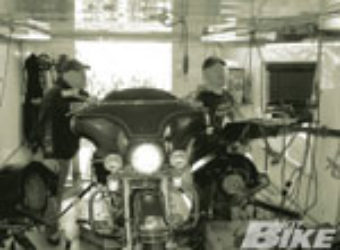
Tuning and Dyno Testing: Proper tuning and dyno testing are essential to optimize the performance of a motorcycle engine turbo system. This involves adjusting fuel maps, ignition timing, boost levels, and other parameters to ensure reliable and consistent power delivery while maintaining engine durability. Trask has an in-house dynamometer and a dedicated technician to handle all the runs they do for their customers. We ran our Low Rider ST on the dyno after the installation was complete and left with a whopping ? hp and ? lb-ft of torque after about 3 hours of installation time (while taking photos!). Adding 40 or more horsies in that amount of time is worth the effort alone.

Basic Turbocharging Terms
Boost Pressure Function: How does boost pressure function? Boost pressure is the additional air pressure above atmospheric pressure supplied to the engine by the turbocharger. It increases the density of the intake air, allowing for a higher fuel-to-air ratio during combustion.